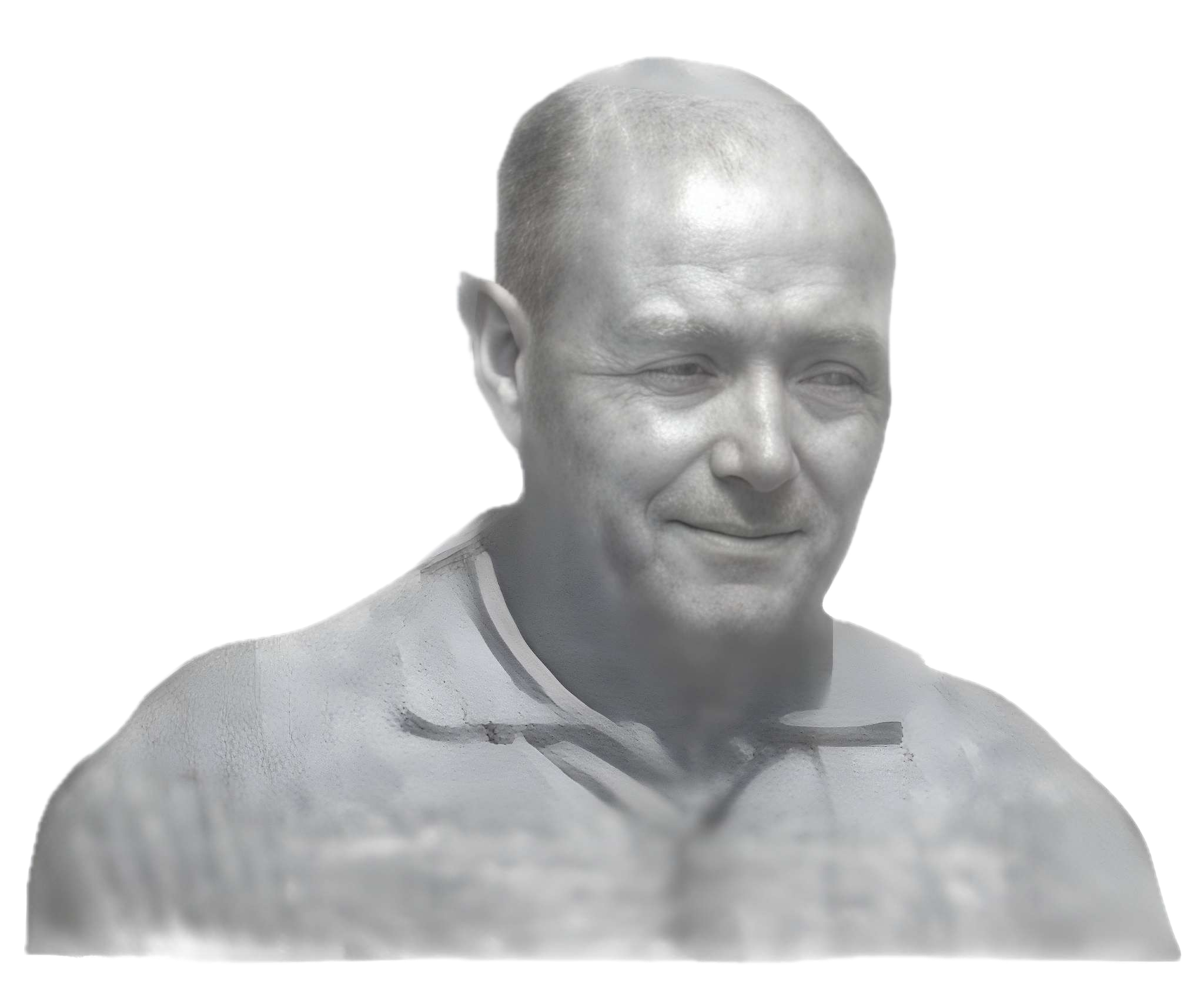
Prof. Victor Tibacu
Estimated reading time: 4–5 minutes
“And, what is very important: he had a sense of humour. An extraordinary sense of humour, but with the face of an accountant who has just discovered you have made an error of one leu and regards you as an international criminal.”
The first lesson with Tibacu: sport was not a “break,” it was “character.”
He had been my physical education teacher since the fifth form. A detail that sounds almost exotic today: eleven years in the same school, with the same corridors, the same courtyard, the same gymnasium, the same assembly hall where the band Cometele came to play for us, and the same people who had watched you grow up. They knew how you stood, how you spoke, how you cheated when you thought nobody was looking.
With Tibacu, we began with athletics — the fifty-metre hurdles.
It is an honest sport: it does not ask how you are feeling today, it does not negotiate, it does not accept “I’ve had a hard week.” If you do not lift your knee, you fall.
If you are afraid, you will most certainly hit the hurdle. If you are overconfident, you will hit it just as certainly.
It is the perfect sport for adolescents: it demonstrates swiftly that optimism without technique is merely a short poem.
After athletics came gymnastics, through to the seventh form. There Tibacu was in his element: severity, execution, repetition, and severity again. In the memoirs of other alumni, it is noted that he employed modern training methods, including circuit training, and that he took his role seriously, going so far as medical examinations and individual corrective programmes — things which today seem more like a “performance improvement programme” than a physical education lesson. (Class of 1972, Upper Sixth D)
Only he did it with the naturalness of a man who does not “execute a concept,” but simply does his job.
And, what is very important: he had a sense of humour. An extraordinary sense of humour, but with the face of an accountant who has just discovered you have made an error of one leu and regards you as an international criminal.
I remember that he would deliver absolutely scandalous jokes with the gravity of a manager reporting to his shareholders. The joke was neither announced nor prepared; he did not wink. He would hurl the expression in your face and leave you to manage it morally.
“Whatever profession you choose, you must do it perfectly… If you become a cesspit cleaner and you tell a client you have extracted one cubic metre of muck, then it had better be exactly one cubic metre of muck. I have known remarkable cesspit cleaners who married their daughters off very well.”
I memorised that phrase not out of vulgarity (which at that age still sharpened you), but because of a hidden lesson: accuracy is a form of respect. If you lie in your units, you lie in yourself.
In a testimony published by former pupils, another kind of humour surfaces: he would use absurd terms and threats about “aschimodii” — and looked so deadly serious that for a few seconds he had you convinced it was a real disease. (Class of 1972, Upper Sixth D.)
That was his hallmark: the joke was seamless.
Basketball: a place where Tibacu taught not only set plays, but also useful shame. When I entered the lycée, still at Șincai, I was selected for the school basketball team. It did not merely mean that you “loved basketball.” It meant that someone had noticed you, valued you, and said: “You can make something of this.” And for Tibacu, “you can make something of this” was not merely a hope. In the fourth form, I became team captain.
We were playing a match in the “Pit” at the Faculty of Law. Those who know the place will understand: the cinder, the dust, grazed knees and balls that bounce like bad ideas — which is to say, often. At a certain point, Tibacu decided I was not releasing the ball. That I was holding on to it, overcomplicating things, not using the plays we had drilled in training. And instead of shouting like a normal coach — which would have been banal and therefore forgivable — he did something infinitely more effective: he knelt down on the edge of the court, on the cinder, and began to implore me. Seriously. Naturally. As though there were nothing theatrical in the gesture. — “Release the ball… How else can I put it to you?” He said this in the same voice with which he might have asked you not to make a mistake in a simple multiplication. Without sarcasm, without anger. Only the calm despair of a man who sees that his pupil is about to sabotage himself. And what a waste. In that moment, I understood something one does not usually grasp at the age of sixteen: the teacher was not angry with me. He was angry with my extravagance. That I had something in my hands and was not using it properly. And I “released the ball.” Because when a man like Tibacu begins to beg, it is clear that you have gone too far in your stubbornness. After the match ended he behaved perfectly normally, making no reference whatsoever to the incident. Another lesson.
A battle cry, collective energy, long before it was called “team building.” I learnt later (and this was confirmed when I read the memoirs of other alumni) that Tibacu used a refrain — “ALABIO-ALABAO…” — adapted as an energising war cry. He would launch it like a psychological button, and suddenly the exhausted class was transformed into a team that “simply conquered the world.” (Class of 1972, Upper Sixth D.)
When you read it today, you smile: “How charming, a sort of motivation.”
But if you think about it carefully, this man was practising group management before the word had entered the school’s vocabulary.
He knew that after exertion, you need a finale — not merely muscular relaxation, but also a mental “fulfilment.” You had to feel that you were going through something together.
I saw him again at a reunion ten years after leaving school. There he said something that struck me, as both a compliment and a joke without a punchline:
Had I been taller, he would have supported me in a career as a basketball player.
It is a typically Tibacu expression. It is not sentimentality. It is not “oh, what talent you had.” It is a cold statement of fact: talent exists, but biology is biology. And yet there was a form of respect in it: the fact that he really had thought of me in those terms. That he saw me “further” than the next match.
I laughed. What else could I do? But there was also that vague feeling within the laughter, that good teachers remember you differently from the way you remember yourself: not by marks, not by excuses, but by potential.
What, in truth, remains of Tibacu? When you say “Victor Tibacu,” many alumni react instantly. Not because he was handsome. But because he was clear. In the published memoirs, he appears as a teacher who worked with modern methods (circuit training), who quantified progress, carried out individual assessments and who never treated a physical education lesson as a “perspiration break.” In university bibliographies, he also appears as an author — for example, with the work “Circuit Training at a Physical Education Lesson” (Stadium Publishing House, 1974). This shows once more that the man did not improvise: he systematised. He wrote. He left a method behind him. And from those same memoirs, there is an episode that sounds almost incredible today: the notion that he was posthumously awarded the UNESCO Prize for Fair Play/Merit in the field of physical education and sport.
Now, as I follow with nostalgia what happens at Șincai, I realise something: The school has achievements, there are generations, there are statistics. But it also has people who gave it its “name” even before the idea of a “brand” existed.
Victor Tibacu was one of them. In the sports press of the 1950s, he is mentioned among basketball coaches, on a list where his name sits beside the words “honesty” and “seriousness at work” — the sort of compliment that a man like Tibacu would accept without smiling, but would note somewhere in a corner of his mind as a good statistic.
Then, in the 1970s, we find him still in the picture — not as a relic, but as an engine. A report from 1976 at the Gheorghe Șincai Lycée mentions basketball and volleyball training sessions held on Saturday afternoons “under the guidance of Professors Victor Tibacu and Cornel Dinicuț,” with dozens of pupils in the hall. It is a small detail, but it speaks volumes: Saturday afternoon, at an hour when many were “resting,” he was there with his pupils, in his own rhythm. And in 1977, there was even an interview with him at the school bearing a title that, frankly, is more suited to a conductor than to a physical education teacher: “Physical Exercises Are a True Symphony.” I do not know whether Tibacu would have accepted this metaphor without “correcting” it with a look, but at the time he was clearly perceived as a man who knew how to orchestrate effort like a musical score. And years later, the legend endures. In an article from 1987, someone states outright that he had seen “such excellent physical education lessons” only at Șincai, “with Victor Tibacu.” That is another level entirely: he was not merely a good teacher, but a standard.