Chapter 4
Estimated reading time: 6–7 minutes
“Gentlemen,” he began, blithely ignoring the five young women in our group, “today you will interact for the first time with a computing machine. Not just any machine, but MECIPT, the electronic brain of Timișoara.”
My first encounter with a computer was in 1968, in my second year at university.
It was rather like meeting an extraterrestrial — fascinating, mysterious and slightly terrifying. The computer was called MECIPT (the Electronic Computing Machine of the Polytechnic Institute of Timișoara) and it occupied an entire room, a technological monster fed on punched tape and the patience of its students.
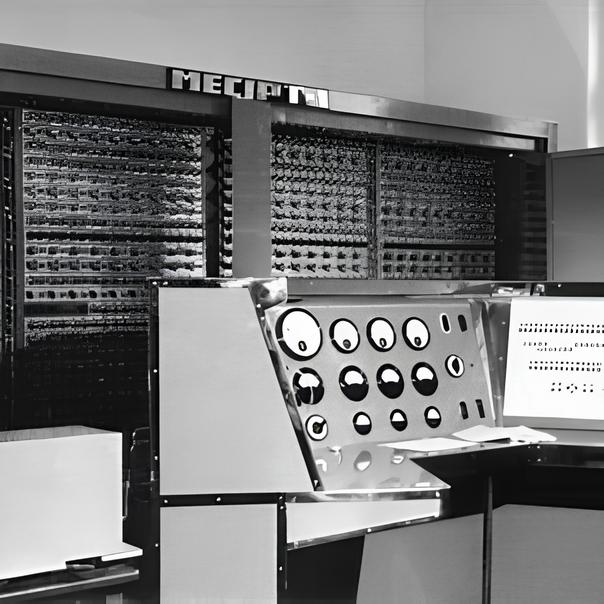
When I first entered the MECIPT hall, I felt as though I had stepped into a cathedral of technology. The air was almost cold, maintained by a ventilation system that hummed discreetly in the background. MECIPT stood there, imposing, its panels full of flickering lights, like stars breathing to their own cosmic rhythm. The magnetic drum, the heart of the system, was visible through one of the side panels — a cylindrical structure that rotated with a hypnotic regularity. On the floor, thick cables snaked between tall metal cabinets, each containing circuits and components whose functions I did not yet understand. The operators moved through this world with an almost religious reverence, speaking in whispers, as though too much noise might disturb the thoughts of the machine.
I did not know then that this was what one of my principal working environments would look like for the next twenty-three years.
Nor did I know that stepping from the cold into the summer heat for a cigarette would cost me many a meal and many days of head colds, precisely when it was unbearably hot outside.
The professors in Timișoara told us it would be a pity to miss this opportunity to see what a computer truly looked like. I remember the day I wrote my first programme. Professor Iosif Kaufman, a respected mathematician and the leader of the group that had created MECIPT, received us in the laboratory, accompanied by his assistant, Radu Mărușteru, an athletic man with a sporting air about him who did not seem in the least to be devoted to the academic field (though, in truth, he excelled in both). Professor Kaufman was more interested in the theoretical principles of his machine, whilst his assistant could not help casting a few admiring glances at my female colleagues. Everyone has their own priorities.
“Gentlemen,” the professor began, ignoring entirely the five young women in our group, “today you will interact for the first time with a machine. Not just any machine, but MECIPT, the electronic brain of Timișoara. We ask that you conduct yourselves properly. The computer has a better memory than you and does not forget mistakes.” Instinctively, we sensed that the professor was joking, so we all smiled politely. His tone did not suggest a joke, but our smiles did not trouble him.
The man: Iosif Kaufman — reserved, meticulous, very likely always dressed in a suit, the quintessence of pure mathematical rigour. Iosif Kaufman was the “mathematical mind” behind MECIPT-1; he developed the logic unit of this computer. He was a man who “said little,” but whose words carried weight. He was the sort of person who commanded respect, above all from those who heard him speak and observed how he conducted himself.
The machine: MECIPT — an immense mass of metal and cables, which occupied an entire hall on the first floor of the Faculty of Electrical Engineering, and which its creators proudly called “the electronic brain of Timișoara.” It had a “massive” memory of 1,024 words of 32 bits each.
“You must think like a machine,” the professor continued. “A computer has no intuition.” “You must tell it exactly what to do, step by step, instruction by instruction.” This was clearly a serious statement, so we all nodded in agreement, although we did not entirely understand what the professor meant.
Then Radu Mărușteru, the professor’s assistant at the time, took charge of us.
I rather expected him to begin with “Ladies…,” but he did not. He taught us how to programme directly in machine code.
He explained the registers, internal and external memory, and other components — concepts that seemed to have sprung from a science fiction novel but which, in fact, formed the foundation of any computing system.
He explained that we should think of a computer as a system composed of subsystems: input (punched tape) / output (a kind of console, like an electric typewriter), internal memory, external memory (a magnetic drum).
It was fascinating.
The assistant Radu Mărușteru was extraordinary.
In the mornings we programmed, and in the afternoons he took us to the beach, somewhere along the Bega.
He loved programming and he loved teaching others.
Radu Marusteru was an athletic man. He was known for his passion for sport. Despite his appearance, which did not fit the stereotype of the bookish academic, Radu Mărușteru was an exceptional mathematician and a software engineer of remarkable rigour. He was the one who descended from the “ivory tower” of theory (where Professor Kaufmann resided) into the “engine room” (where the actual work with MECIPT was done).
He was the one who had mastered machine language, registers and hardware architecture. He was the “translator” between Kaufmann’s abstract logic and the physical reality of a computer with 2,000 vacuum tubes.
The fact that he taught us machine code directly shows a pragmatic approach. He understood that in order to master a system, one must understand its foundations. He had a holistic vision. Radu Mărușteru went on to a brilliant career, becoming a full university professor and a recognised authority in Numerical Analysis and Programming. He published standard works of reference in the field and trained generations of computer scientists at the West University of Timișoara.