Chapter 7
Estimated reading time: 7–8 minutes
“In my youthful imagination, fed on the films of my childhood, I already saw myself in the mountains, rifle in hand, fighting the invaders… exactly like the Russian partisans I had seen in the Soviet films. Ironically, I had no other models of partisans…”
After my practical placement in Timișoara, I returned to Bucharest.
I was brimming with impressions, with the memory of that electronic computer, built with the technology of its time — a serious combination of science and engineering improvisation, but without any doubt a step towards the future.
Everything seemed, for a moment, calm.
But in August 1968, our world was to be shaken to its foundations.
The Prague Spring was crushed beneath the tracks of Soviet tanks.
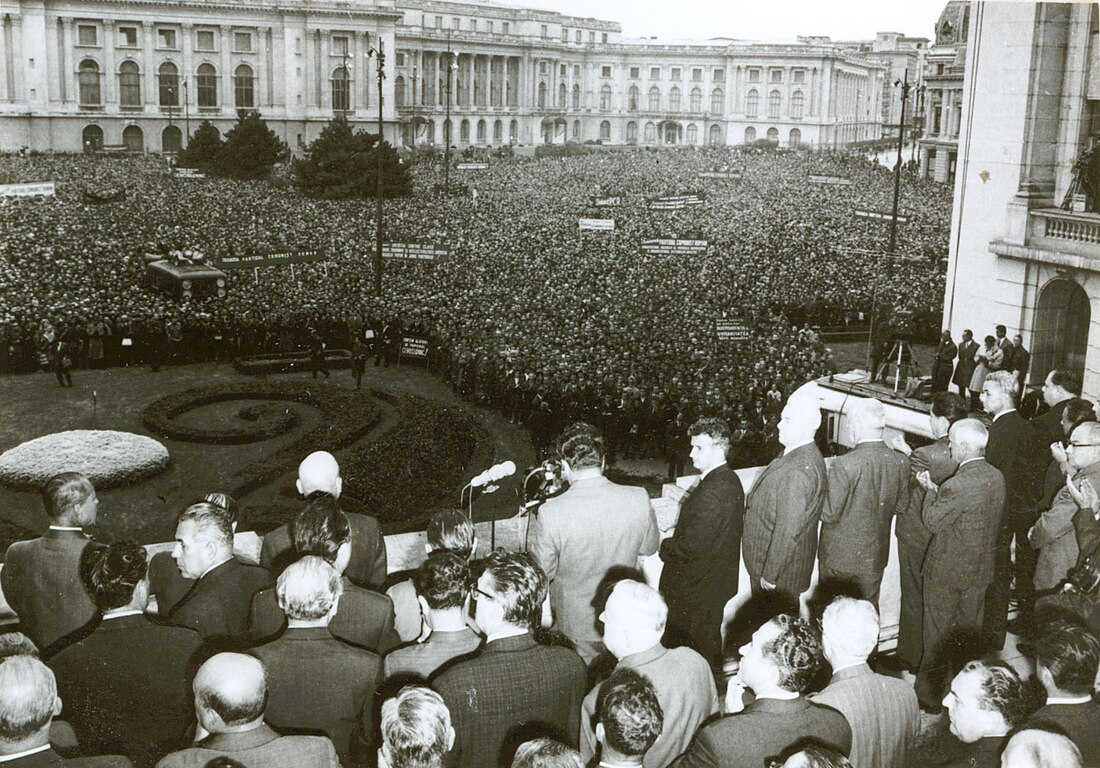
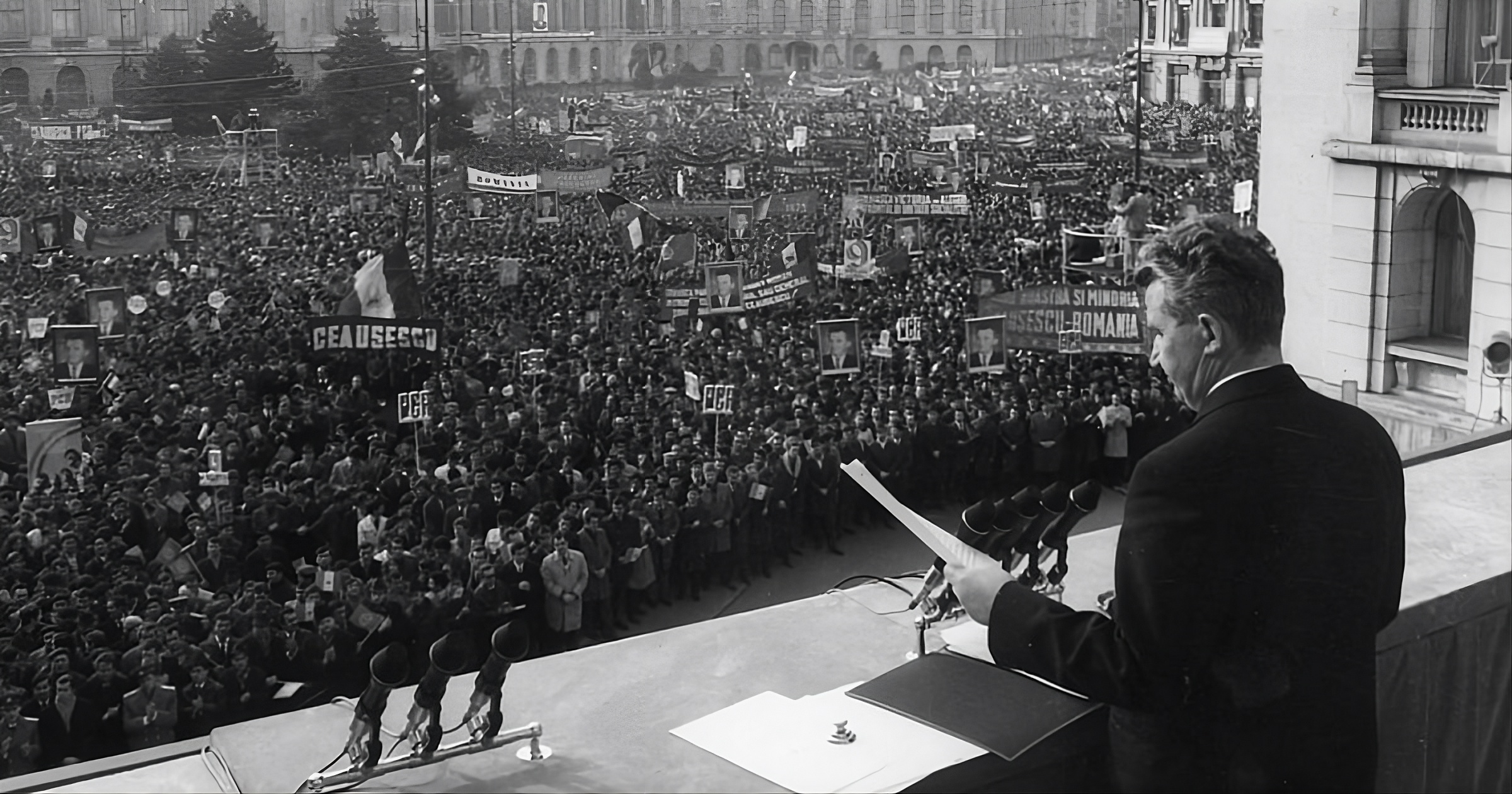
Romania, through the voice of Nicolae Ceaușescu, was the only country in the Eastern Bloc to condemn the invasion publicly.
I remember it as though it were yesterday: I was in Piața Palatului (as it was called then; today it is Piața Revoluției — Revolution Square) alongside thousands of people, cheering Ceaușescu’s speech in which he announced that the Patriotic Guards would be armed to defend the country’s independence.
In my youthful imagination, fed on the films of my childhood, I already saw myself in the mountains, rifle in hand, fighting the invaders… exactly like the Russian partisans I had seen in the Soviet films. Ironically, I had no other models of partisans beyond those so generously screened in the cinemas.
In those turbulent days, Romanians displayed a remarkable hospitality: Czech students, tourists and families stranded in Romania were welcomed willingly into our homes. Television reported such gestures with pride. It was living proof that, regardless of the political context, ordinary people can remain human.
There was a glimmer of hope: that perhaps we would become different, that Romania would breathe a cleaner, freer air.
How gravely mistaken I was… But I shall tell all in due course.
Meanwhile, the university years continued to bring with them a strange mixture of old and new, which I would later come to call “the Romanian Paradox.” Our subjects of study reflected this paradox perfectly.
In the very same week we might learn about the Odhner wheel, tabulators, sorters, card-punching machines and verifying machines, and then attend a lecture on “Economic Cybernetics” delivered by none other than Academician Edmond Nicolau.
After which we would learn how to organise a computing station based on punched cards, before being invited to acquaint ourselves with the concepts of closed systems, open systems, feedback and other marvels of cybernetics.
Once we had finished with the theories of punched cards, the professors took each of us on like apprentices in a workshop of time. They taught us about the Odhner wheel, as though we were destined to work in a manufactory of calculations.
Wilgodt Theophil Odhner — a name of Scandinavian resonance, although the man was a Swedish engineer who had been Russified — had invented in the nineteenth century a small mechanical miracle: a portable calculating machine based on a system of toothed wheels and movable axles. The Odhner wheel was the central nerve of that apparatus: a small but cunning piece that could add, subtract, and — with a measure of patience — even multiply or divide, through successive rotations and precise clicks.
It held in one hand the entire computing power of an accountant’s office.
Our professor, an elderly gentleman with the fingers of a pianist and nerves of steel, explained how it was to be used: — If you know how to operate the Odhner wheel, you know how to understand how a computing machine works. Because a computing machine does not “think” — it merely executes. And it executes… to the millimetre.
We had learnt to handle it with an almost religious respect.
But what was truly fascinating, at least for me, was the organisation of a computing station.
Far from being a tedious collection of machines, a well-organised computing station resembled a complex orchestra, in which every instrumentalist had his own score. We calculated how many punched cards we needed to keep pace with the speed of the tabulator — for it did not wait for the clumsy. We calculated how many sorting machines we should connect in order to redistribute the cards by code before the tabulator began to scream from its printer that it had nothing to read. We determined how many verifying machines had to be allocated — because a single error on a punched card meant starting all over again.
And all these apparently fruitless calculations were dictated by the nature of the computations involved in each project: if you had lengthy calculations, such as payrolls or enormous invoices, the size of the station was different from that needed for simple statistics or inventory tables. Behind every organisational plan lay dozens of hours of engineering work. This was by no means “copied from the West” — it was a serious construction, an authentic systems thinking, written in pencil on a blackboard and transferred to the heavy floors of the departments for the mechanisation of economic computation.
And there, amidst the tales of Odhner, Babbage and our cards full of holes, we gradually began to understand the bitter and beautiful truth: progress means not only grand visions, but also painstaking work, ant-like, at every step.
The true pioneers.
Against the backdrop of these almost initiatory lessons, there also arose the teaching of the field’s true pioneers. We were told with respect about Charles Babbage, the visionary British mathematician who had dreamt in the nineteenth century of an automatic computing machine — the Analytical Engine — capable of performing any kind of operation. The idea of programming with punched cards he had borrowed from the Jacquard weaving looms, where intricate embroidery patterns were dictated by strings of carefully punched holes.
Babbage had dreamt of transforming pages full of formulae into commands for a machine. And in a way, so did we — we dreamt of understanding that world in which logic and precision took the place of inspiration and applause.
And so, slowly and almost imperceptibly, we were witnesses to a rare phenomenon: the setting of one era and the rising of another.
On the one hand, we watched as the electromechanical calculating machines began to end their long reign. On the other, we sensed the discreet but irresistible stirring of the electronic computers, which were making their way onto the stage, exactly like silent actors who change the face of an entire production.
I had the good fortune — or the destiny — to catch this change of epoch, when punched cards still rustled in the computing halls, but somewhere on the horizon, transistors and integrated circuits were beginning to pulse a different music.